
Directory
Discover detailed profiles of PoC companies.

BlueCaBorn
Energy-Efficient Marine Carbon Dioxide Removal Using Artificial Coral Technology

Specialization
Marine Carbon Dioxide Removal
Artificial Coral Technology
Carbon Mineralization

Keywords
Artificial Coral
Artificial Coccolithophore
Marine Carbon Mineralization

Category
Climate Tech
Carbon Removal
Ocean Tech


Technology Introduction
Technology / Item Overview
-
BlueCaBorn develops an energy-efficient marine carbon dioxide removal, m-CDR, solution using artificial coral technology.
-
The company’s core approach captures dissolved CO₂ in seawater and converts it into stable carbonate minerals such as CaCO₃.
-
Its technology is inspired by artificial coccolithophore and artificial coral-based mineralization.
-
BlueCaBorn aims to provide a low-power and scalable alternative to conventional carbon removal methods such as DAC.
Owned Technology / Applied Products
(1) Owned Technology
-
Artificial coral-based marine carbon mineralization technology.
-
Artificial coccolithophore particle technology.
-
Low-power seawater-based CO₂ capture and conversion process.
-
Blue Carbon Trap™ system for marine CO₂ removal.
-
Carbon removal measurement and credit registration process.
-
Cooling water integration model for low-CAPEX deployment.
(2) Applied Products
-
BlueCaBorn™ m-CDR Machine
-
Energy-efficient marine carbon removal system.
-
Captures CO₂ from seawater and converts it into stable mineral form.
-
-
Blue Carbon Trap™
-
Modular carbon removal unit designed for PoC and commercial installation.
-
Can be integrated with existing cooling water supply systems.
-
-
Artificial Coral Particles
-
Basic material for marine carbon mineralization.
-
Supports CaCO₃ formation and long-term carbon sequestration.
-
-
Carbon Credit Solution
-
Supports carbon removal validation, registration, offtake contracts, and credit sales.
-
Development Needs & Value Proposition
(1) Problem Definition / Development Background
-
Around 40 gigatons of CO₂ are emitted globally each year, while a large portion accumulates in the atmosphere and drives climate change.
-
Carbon removal is essential for achieving the 2050 net-zero scenario, beyond emissions reduction alone.
-
Conventional DAC systems require large energy input and face scalability and cost challenges.
-
The market needs scalable, low-energy, and economically viable CO₂ removal solutions.
(2) Value Proposition / Solution
-
BlueCaBorn provides a low-power marine carbon removal solution using seawater and artificial coral mineralization.
-
The system can integrate with existing industrial cooling water infrastructure, reducing CAPEX and improving scalability.
-
Removed CO₂ is converted into stable carbonate minerals, enabling durable carbon sequestration.
-
The company generates value through artificial coral materials, Blue Carbon Trap™ installations, and carbon removal credit sales.
Competitiveness
-
Low-Energy Marine CDR: Uses seawater-based mineralization instead of energy-intensive air capture.
-
Artificial Coral Technology: Converts dissolved CO₂ into solid carbonate minerals such as CaCO₃.
-
Cooling Water Integration: Can utilize existing cooling seawater supply systems for scalable deployment.
-
Triple Revenue Model: Generates revenue from artificial corals, Blue Carbon Trap™ systems, and carbon credits.
-
Carbon Credit Market Fit: Targets voluntary carbon removal credit buyers such as big tech, ESG-driven companies, and hard-to-abate industries.
-
PoC Readiness: PoC facility targeted for readiness by November 2025 and complete data collection in Q1 2026.

Company Performance & Business Status
Key References
-
Developed BlueCaBorn™ as an artificial coral-based marine carbon removal technology.
-
PoC model targets approximately 2 kg CO₂ removal per year as an initial data collection unit.
-
PoC facility planned with Jeonbook Institute of Marine Technology.
-
Business model focuses on high-quality carbon credit production and offtake contract validation.
-
Revenue model combines:
-
Artificial coral sales.
-
Blue Carbon Trap™ installation.
-
Carbon credit sales.
-
-
Roadmap includes PoC installation, carbon credit validation, first carbon credit offtake, U.S. subsidiary setup, and commercial installation.
Overseas Experience
(1) PoC Progress
-
BlueCaBorn plans to validate its PoC facility and collect performance data from 2025 to 2026.
-
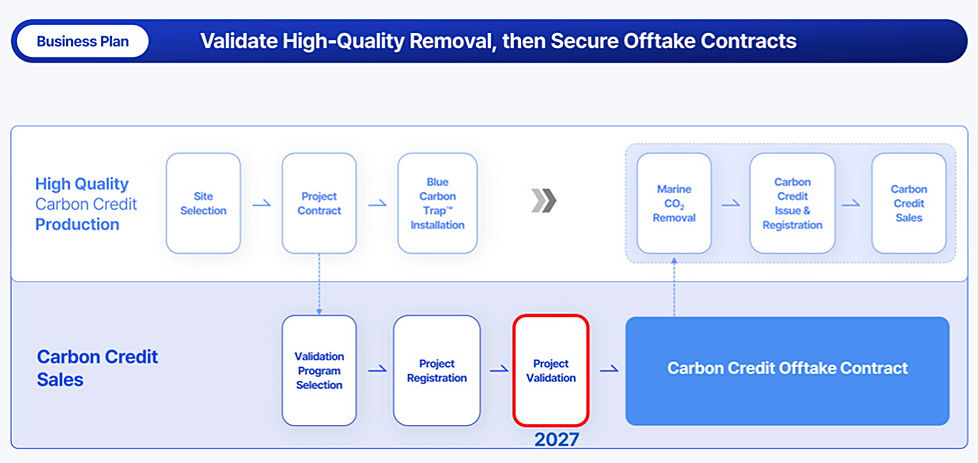
The PoC process includes site selection, project contract, Blue Carbon Trap™ installation, marine CO₂ removal, carbon removal registration, and carbon credit sales.
-
Project validation is targeted around 2027, followed by carbon credit offtake contracts.
(2) Global Expansion
-
BlueCaBorn targets the voluntary carbon removal credit market.
-
Potential buyers include big tech companies, buyer coalitions, ESG-driven companies, aviation, steel, and other hard-to-abate industries.
-
The roadmap includes setting up a U.S. subsidiary, scaling artificial coral manufacturing, completing carbon credit validation, and commercial Blue Carbon Trap™ installation.
-
Long-term target includes reaching large-scale marine carbon removal capacity by 2050
